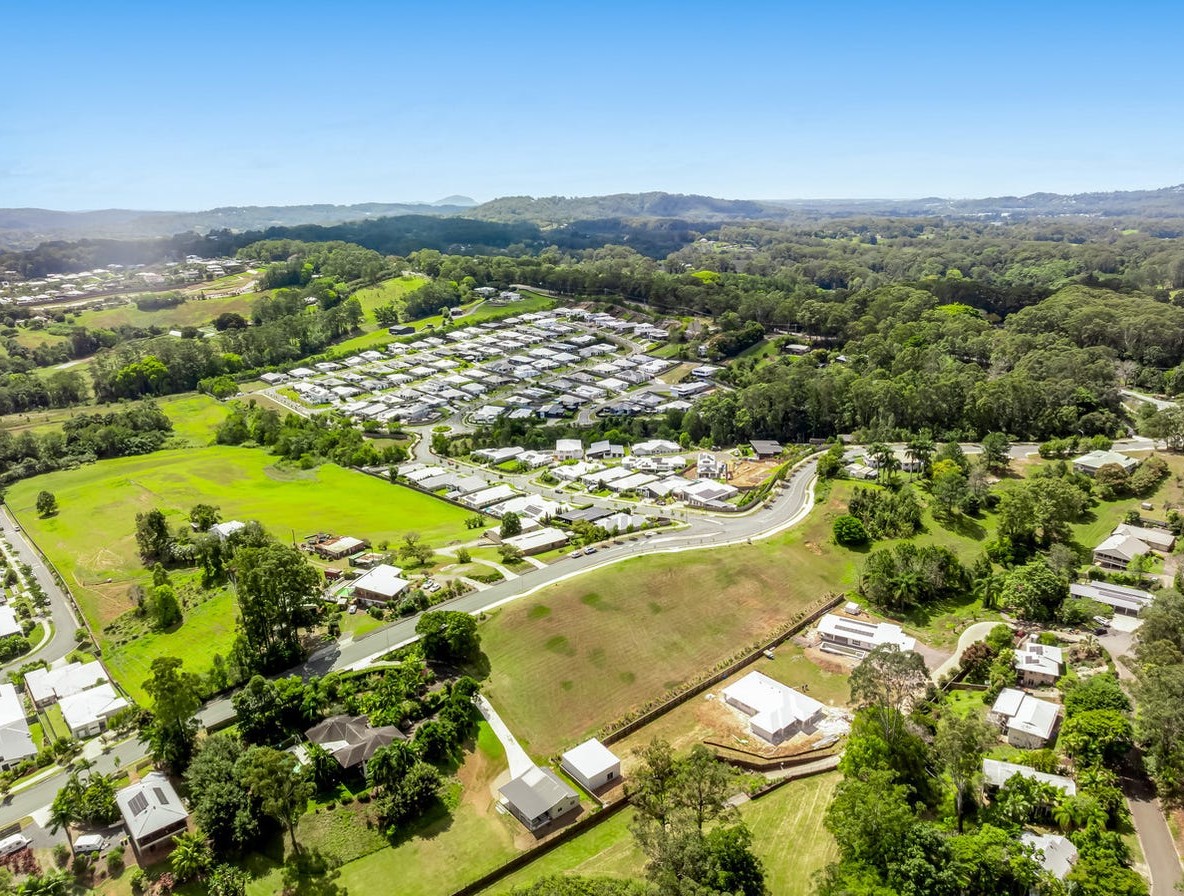
From Subdivisions To Townhouses: What's Driving Development Demand in SEQ & How To Fund It
Twenty years ago, most residential developers in South East Queensland could build a successful business around a single strategy: greenfield land subdivision. Buy a parcel in a growth corridor, subdivide it into lots, and sell to families who wanted a house and a backyard. The fundamentals were reliable, the funding was straightforward, and the market was deep.
That model still works in the right locations. But it no longer reflects the full opportunity set in SEQ, and developers who treat it as the default are increasingly misreading the market.
Today, successful SEQ developers are actively evaluating a broader range of project types: townhouse complexes on infill sites, duplex developments on subdivided lots, boutique apartment buildings in urban precincts, and staged residential estates in emerging regional centres. Each of these project types responds to a different set of demand drivers, requires different site selection criteria, carries a different risk-return profile, and demands a different funding structure.
This guide is written for developers making those decisions. It covers demand shifts, regional drivers, and funding structures for each major development type, with practical guidance on where Assured Management fits in.
The scale of that opportunity is significant. SEQ is projected to absorb more than two million additional residents by 2046 (Queensland Government population projections). That’s not a market condition; it’s a structural demand mandate for housing of every type, in every corridor, across the next two decades. Developers who align project selection with underlying demand trends may be better positioned to build a durable business in that environment.
In This Guide:
- Where subdivision demand remains strongest across SEQ, and why it’s becoming more location-dependent
- Why townhouse and duplex projects are the fastest-growing segment in SEQ, and what makes them work financially
- How structural changes in household formation and affordability are reshaping buyer demand across all price points
- Which development types suit each SEQ region, Ipswich, Logan, Brisbane, Gold Coast, and Toowoomba
- Detailed funding structures for each project type, subdivision finance, construction drawdowns, pre-sales, and apartment project monitoring
Why Developers Are Expanding Beyond Traditional Subdivisions
Three structural forces reshaping SEQ development demand:
- Population growth — Queensland grew 2.4% in 2022–23, the fastest of any Australian state (ABS). Most of that growth is landing in SEQ; each arriving cohort demands a different product type.
- Shrinking households — average household size fell from 2.9 to 2.5 people between 2001 and 2021 (ABS Census). Structurally less demand for large homes, regardless of affordability.
- Affordability pressure — Brisbane’s median house price surpassed $1 million in 2025, up 76% since 2020 (Cotality/CoreLogic). Single-dwelling development on established infill sites no longer stacks in many locations.
1. Population Growth Is Accelerating — and Concentrating
Queensland's population grew by approximately 2.4% in 2022–23, the highest growth rate of any Australian state (ABS, 2023). The majority of that growth is landing in SEQ: Brisbane, the Gold Coast, Ipswich, Logan, and the Sunshine Coast are each absorbing significant new household formation.
What matters for developers is not just the volume of growth but its composition. New residents arriving in SEQ do not represent a single buyer type. They include interstate families relocating from Sydney and Melbourne, international migrants, young professionals, retirees seeking coastal lifestyle at lower price points, and multigenerational households looking for affordable space. Each cohort has different product preferences, and each creates demand for a different development type.
2. Household Sizes Are Getting Smaller
The ABS Census records a consistent decline in average household size across Australia: from 2.9 people in 2001 to 2.5 people in 2021. This is a significant structural shift. Applied across SEQ's projected population growth, it means significantly more households are being formed per capita than historical models would suggest, and those households increasingly do not need a four-bedroom house on 600 square metres.
Single-person households now represent approximately 25% of all Australian households. Couple-only households represent a further 25%. Together, households with no dependent children are demanding housing that is smaller, lower-maintenance, and better located, which is precisely the profile of a well-designed townhouse or boutique apartment.
3. Affordability Is Redirecting Buyer Behaviour and Developer Strategy
Median house prices in Brisbane's middle ring have risen sharply since 2020. Brisbane's median house price surpassed $1 million in 2025, up more than 76% from $558,000 in June 2020 (Cotality/CoreLogic). Suburbs like Moorooka, which sat at around $590,000 in 2016, are now trading above $1.2M. That pricing shift has two consequences developers need to understand:
- Owner-occupiers are trading lot size for location, accepting a townhouse or duplex in a preferred suburb over a larger home on the fringe.
- Developers are finding that a single dwelling on an established site no longer produces an acceptable feasibility outcome, but two dwellings on the same land often do.
Both of these forces are structural. They won't reverse when interest rates change. The affordability gap between detached housing in preferred locations and higher-density product has become a permanent feature of the SEQ market.
The Three Main Development Types: Demand, Risk, and Returns
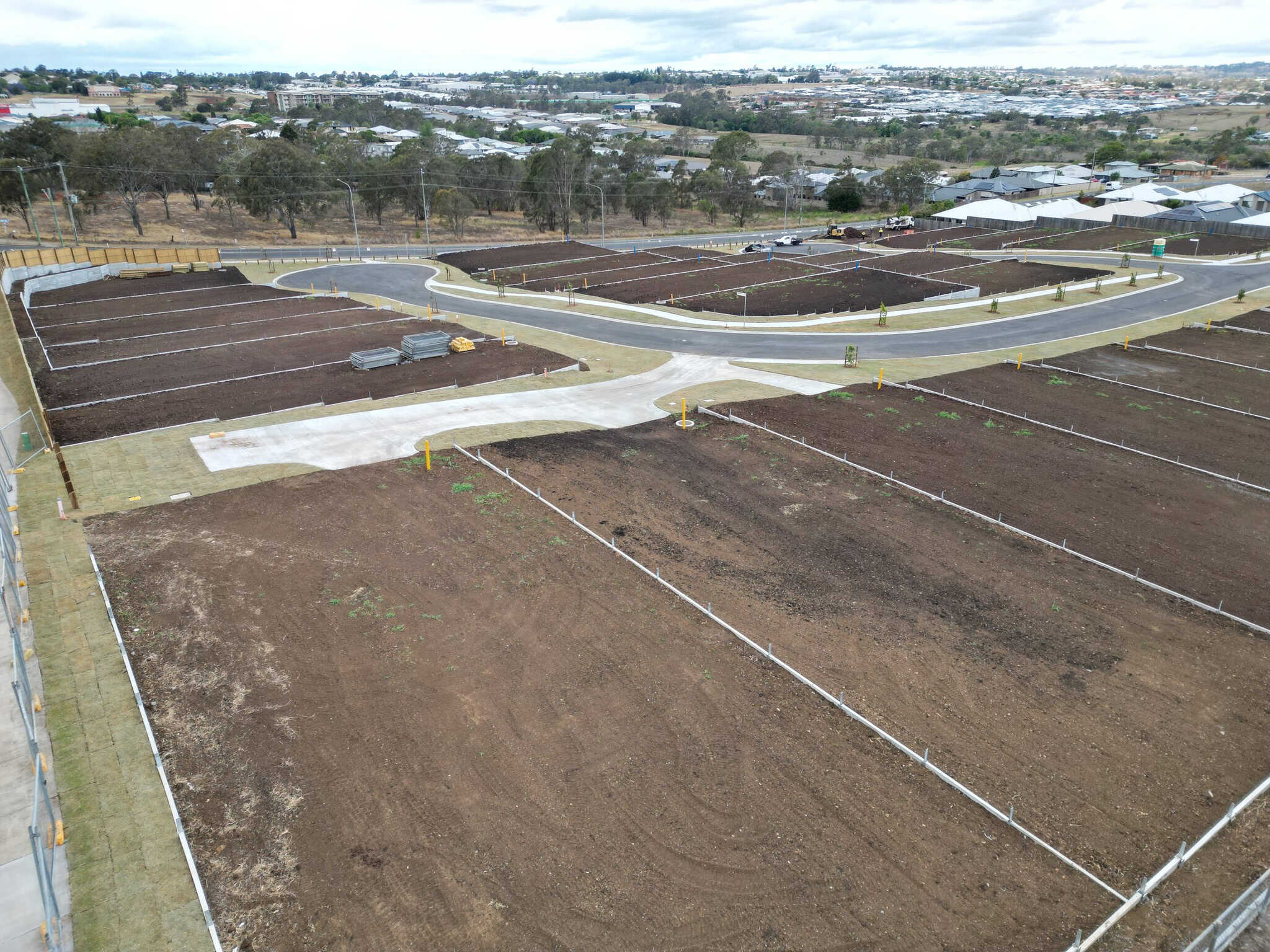 Land Subdivisions
Still the dominant model in SEQ's outer corridors. Higher upfront capital, longer cash-flow timelines, and strong scalability. Suits developers with subdivision experience and access to staged construction finance.
Buyers are predominantly first-home buyers and young families supported by government grants. Risk is concentrated in the early stages: civil costs, holding costs, and council contributions all run ahead of revenue by 12–24 months on larger estates.
The primary risk variables are civil cost overruns, delays to council approvals, and the timing of lot settlements against finance maturity dates. Individual lot margins are tighter than on townhouse or apartment projects, but the scalability of staged greenfield releases means well-structured subdivision programmes can generate substantial total returns.
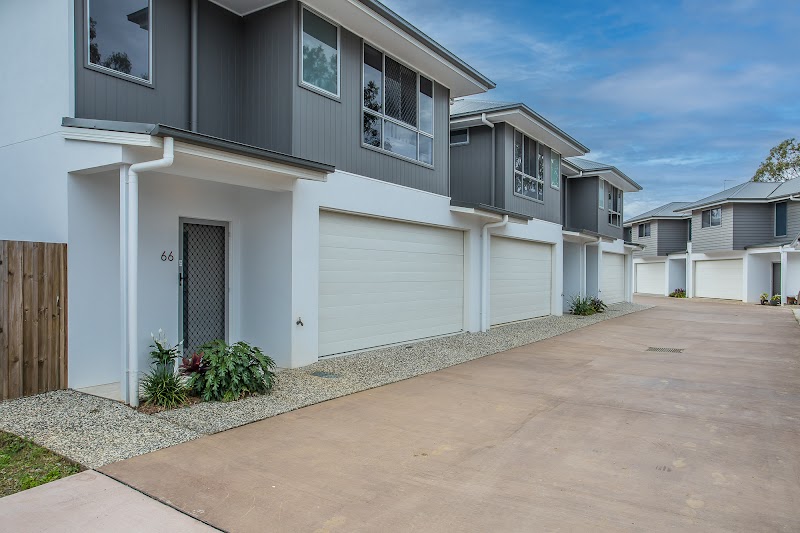 Duplexes and Townhouses
The fastest-growing infill strategy in SEQ. Shorter programmes, dual buyer pools, and stronger per-site yield than subdivision on established land. More accessible to smaller developers.
For developers, the appeal is straightforward: a single site yields two or more sellable dwellings, construction timelines run 10–14 months from slab to practical completion, and the buyer pool spans both investors and owner-occupiers.
The feasibility logic is straightforward. As an illustrative example: a middle-ring site at around $900K supporting two townhouses at $650K–$700K each produces a gross realisation of $1.3M–$1.4M. Against total development cost, including land, construction, GST, and holding costs, a viable margin is achievable where a single dwelling on the same site would not produce the same outcome. The same site developed as a single dwelling rarely achieves the same outcome.
The primary exposure is more contained than on apartment projects. There are no body corporate complications during the construction phase, no 50-unit pre-sale programme to manage, and the shorter construction period reduces exposure to cost escalation. The main variables are builder quality, fixed-price contract structure, and whether pre-sale prices are achievable in the local market, not projections based on neighbouring suburbs.
The segment is particularly active in Brisbane's infill suburbs, Moorooka, Stafford, Zillmere, Wynnum, and in Logan's growth areas around Springwood and Marsden. Duplex activity is strong wherever smaller infill sites exist and council zoning supports dual occupancy.
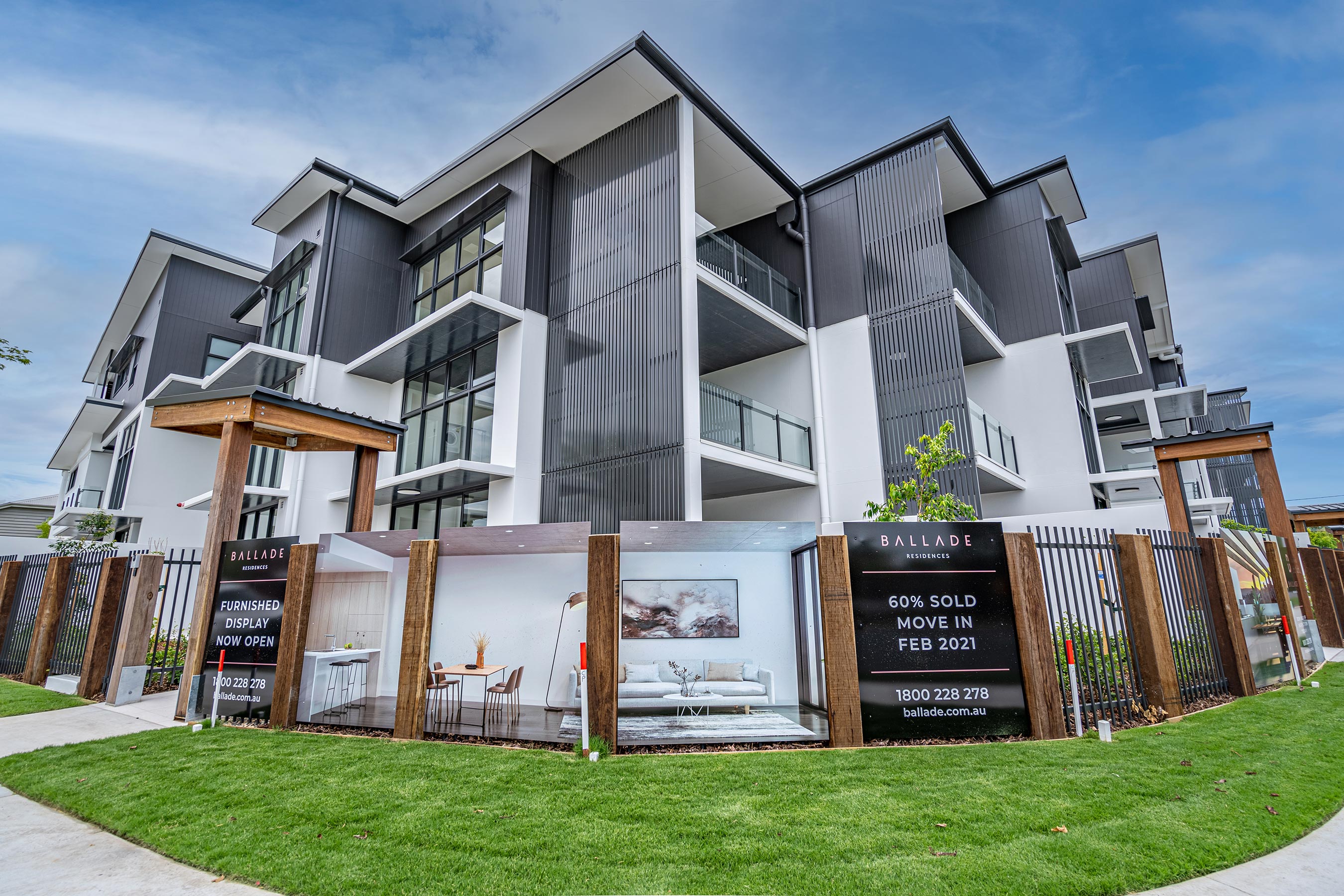 Medium-Density Apartments
Highest complexity and longest lead times. Strong demand in inner Brisbane and coastal Gold Coast precincts. Requires earlier lender engagement and more rigorous feasibility management than other types.
Apartments serve demand that subdivisions and townhouses cannot: the urban-lifestyle buyer who wants to be within walking distance of employment, transport, and amenity, with no interest in maintaining a garden.
The demand base is different. In Brisbane's inner and middle ring, Newstead, West End, Teneriffe, Albion, apartment buyers skew toward professionals, downsizers, and interstate migrants seeking Brisbane exposure. On the Gold Coast, the driver is lifestyle: Southport, Labrador, and Burleigh are absorbing buyers who want coastal living without the price of beachfront detached housing.
The development profile has shifted since the 2010s. The current SEQ apartment market is showing stronger demand for boutique, design-led buildings of 12–40 units than for large-scale towers. These projects are expensive to initiate, design fees, certifier costs, development application timelines, and pre-sale requirements all precede a slab, but they can produce strong per-unit margins in the right precincts.
Key sensitivities are programme length and cost escalation. Construction programme length creates extended exposure to cost escalation. Pre-sales requirements mean revenue is conditional on market conditions at the time of marketing. The lender relationship matters more here than in any other segment. A financier who understands feasibility modelling and project monitoring makes a practical difference to project outcomes.
Multi-Generational Living: An Underserved Demand Driver
Multi-generational living rarely gets its own section in development finance writing, yet it sits squarely in the feasibility zone of duplex and dual-occupancy development.
Multi-generational households, defined as three or more generations living in the same dwelling or on the same lot, have increased consistently across Australia over the past decade. In SEQ, the trend is most visible in Logan, Ipswich, and Brisbane's south-western fringe, where affordability pressure, cultural household patterns, and the availability of larger land parcels align.
What these buyers want is specific. Not a large single dwelling where three generations share one kitchen and one living area. They want a configuration that provides proximity with separation: two dwellings on the same lot, or a principal dwelling with a secondary self-contained residence. The duplex format, or a house with a detached secondary dwelling, serves this need directly.
The development implication is significant. Dual-occupancy products designed with multi-generational buyers in mind, separate entries, adaptable floorplans, shared outdoor space that still allows privacy, command a genuine demand premium over standard investor-grade duplexes. Developers who understand this buyer type are building product that performs differently in the pre-sales market.
Regional Development Overlay: Where Each Strategy Works
Region |
Strongest Product |
Key Driver |
Finance Focus |
|
Ipswich |
Land Subdivisions, house-and-land |
Population growth, first-home buyer demand |
Staged subdivision finance |
|
Logan |
Subdivisions, duplexes, townhouses |
Growth corridors + gentle density policy |
Construction & subdivision funding |
|
Brisbane |
Townhouses, boutique infill apartments |
Land scarcity, densification, owner-occupiers |
Construction finance, pre-sales |
|
Gold Coast |
Medium-density apartments, lifestyle product |
Lifestyle migration, limited site supply |
Apartment construction, feasibility review |
|
Toowoomba |
Greenfield estates, residential land |
Infrastructure investment, affordability |
Land acquisition, staged releases |
Ipswich: Greenfield Subdivision and House-and-Land
Ipswich is the most active greenfield development corridor in SEQ. The Ripley Valley Priority Development Area is planned for approximately 50,000 dwellings (Ipswich City Council planning framework). Infrastructure investment, the Springfield rail extension, road upgrades throughout the western corridor, and ongoing school and services delivery, is supporting consistent lot absorption.
The buyer profile is predominantly first-home buyers and young families. This creates a strong government grant tailwind (the Queensland First Home Owner Grant remains available for new builds), but it also means developers need to price lots and house-and-land packages carefully: the buyer is affordability-sensitive and has limited tolerance for premium pricing.
Logan: Growth Corridors and Gentle Density
Logan is doing two things simultaneously, which makes it one of the more interesting development markets in SEQ. Its outer growth corridors, Yarrabilba, Flagstone, Jimboomba, are continuing to absorb greenfield subdivision activity at scale. Its established suburbs, Springwood, Marsden, Loganholme, are seeing increasing duplex and townhouse development driven by land values that now make single-dwelling development less viable.
Logan Council's planning framework has been progressively supportive of dual occupancy and gentle density in established areas. Developers who understand both modes of Logan's market, greenfield in the outer corridor and infill in the established suburbs, have the broadest opportunity set.
Brisbane: Infill, Townhouses, and Boutique Apartments
Brisbane's development market is constrained by land supply in a way that Ipswich and Logan are not. Available sites in the inner and middle ring are smaller, more expensive, and subject to more complex planning requirements. That constraint is also what drives development value. Brisbane inner-ring townhouses and boutique apartments are achieving price points that outer-corridor product cannot.
Council planning policy under Brisbane 2032 infrastructure planning is progressively supporting densification along transport corridors. Developers who identify sites within walkable distance of train stations and major bus routes in the middle ring, Nundah, Zillmere, Moorooka, Annerley, are accessing rezoning tailwinds that increase development potential.
Gold Coast: Lifestyle Apartments and Coastal Density
The Gold Coast's development market is driven by lifestyle demand in a way no other SEQ market replicates. Interstate migrants and domestic investors seeking coastal exposure have supported consistent apartment pre-sales even through periods of broader market softness. Southport, Labrador, and parts of Burleigh and Broadbeach are the most active precincts for boutique medium-density development.
Available development sites on the Gold Coast are becoming genuinely scarce, the result of decades of development absorbing coastal and near-coastal land. That scarcity is precisely why medium-density and vertical development keeps receiving approval: the council has limited alternatives for accommodating population growth without it.
Toowoomba: Emerging Greenfield and Regional Growth
Toowoomba is the most compelling emerging story in the SEQ development market. The Inland Rail project and the Toowoomba Second Range Crossing have materially changed the region's economic trajectory. Toowoomba is attracting businesses and residents priced out of coastal SEQ, and land affordability still allows for greenfield estates at price points well below coastal SEQ — the Queensland Government’s most recent valuation data puts the median residential land value in the Toowoomba Regional LGA at $265,000, a fraction of Brisbane equivalents.
Development Finance: A Detailed Guide by Project Type
Getting the funding structure right is not a secondary consideration. A mismatched finance structure is one of the most common reasons viable projects run into difficulty: a construction facility that matures before lot settlements are complete, a drawdown schedule that doesn't match the civil programme, a pre-sales threshold that can't be achieved in the local market. Understanding the funding mechanics for each project type is as important as understanding the development opportunity.
Key principle: structure follows project type
A funding structure designed for a land subdivision looks nothing like one designed for a boutique apartment project. A lender who applies a single template across all project types is a risk to the developer, not a support.
Funding Land Subdivisions
Land Acquisition
Subdivision projects typically require a land acquisition facility to fund the purchase before development approval and civil works commence. Lenders assess this against the current-use value of the land, the development potential, and the developer's track record. Loan-to-value ratios at acquisition stage are typically lower than during the active construction phase.
Civil Works and Infrastructure
The civil construction phase, earthworks, roads, drainage, and services reticulation, is funded through a progressive construction facility drawn against certified civil milestones. This is where subdivision finance differs most significantly from building construction finance: drawdowns are tied to infrastructure completion rather than to building stages.
Civil cost overruns are the primary risk in this phase. A well-structured facility includes a contingency allowance, typically 10–15% of civil construction cost, and a monitoring mechanism, usually a quantity surveyor, to certify progress before each drawdown is released.
Staged Releases and Settlement Finance
On larger estates, the commercial logic of staged releases, titling and selling lots in tranches rather than all at once, requires a finance structure that can accommodate multiple stages under a single facility or across coordinated facilities. The central sequencing issue is ensuring that lot settlement proceeds are available to reduce the facility balance before the next civil stage commences.
Funding Duplexes and Townhouses
Construction Finance Structure
Duplex and townhouse construction is funded through a progressive facility tied to building stages: slab, frame, lock-up, fixing, and practical completion. On a duplex project the total facility is typically $800K–1.2M; on a 6–8 unit townhouse complex, $2.5M–4M depending on location and specification.
Pre-Sales Considerations
Pre-sales are not always required for duplex or small townhouse projects where the developer has a track record and feasibility is strong. Where required, coverage is typically expressed as 60–80% of gross realisation. Pre-sale prices must be achievable in the actual local market, not based on neighbouring suburbs or a different market phase.
Progressive Drawdowns and Cash Flow
The shorter construction timeline of townhouse projects (typically 10–14 months) compresses the interest period relative to total development cost. This is a material advantage in the feasibility model. It also means that the development is less exposed to the interest rate and cost escalation risk that longer programmes carry.
Funding Medium-Density Apartment Projects
Greater Complexity — Earlier Engagement
Apartment projects require a lender relationship that starts earlier and runs deeper than for the other two project types. The pre-construction phase alone, design, development application, certifier engagement, pre-sales marketing, can run for 12–18 months before a slab is poured. A lender who is engaged from this stage provides certainty that the finance structure is aligned with the development programme before significant pre-construction costs are committed.
Feasibility Requirements
Lenders assessing apartment projects evaluate the feasibility model in detail: total development cost against gross realisation, with particular attention to the development margin, cost contingency allocation, and the basis for the end-value assumptions. Projects that rely on optimistic end-value assumptions are the ones most likely to encounter problems when valuations are updated during construction.
A robust apartment feasibility, one that a lender will fund, typically shows a development margin of at least 20% of total development cost, a contingency of 10–15% of hard construction cost, and end values supported by recent comparable sales in the immediate precinct rather than the broader suburb.
Project Monitoring
During construction, apartment projects are typically subject to monthly or milestone-based progress reporting from an independent project monitor, usually a quantity surveyor appointed by the lender. This is not an obstacle to be resisted; it is a mechanism that benefits the developer as much as the lender by identifying cost or programme variances early, before they become crisis-level problems.
Quick Reference: Funding Structures By Project Type
Project Type |
Drawdown Structure |
Pre-Sales Requirement |
Key Risk Consideration |
|
Land Subdivision |
Staged: civil milestones + lot titling |
Not typically required |
Civil cost overruns; settlement timing |
|
Duplex / Townhouses |
Progressive: slab → frame → lock-up → PC |
Often beneficial; reduces lender exposure |
Builder track record; fixed-price contract |
|
Medium-density apartments |
Progressive with project monitoring |
Usually required, threshold varies by project |
Cost escalation; programme length; consultant fees |
Assured Management: First-Mortgage Development Finance Across SEQ
Assured Management has been providing first-mortgage construction and development finance in SEQ since 1998. Over 27 years of active lending across multiple property cycles, the company has developed a detailed understanding of how the SEQ development market actually works, the regional differences, the project-type nuances, and the funding structures that support delivery rather than complicate it.
The team works directly with developers, reviewing feasibility in detail and structuring facilities around the specific project type and stage. That direct engagement is the practical difference from institutional lenders where the decision-maker is several steps removed from the project.
- Subdivision finance, land acquisition and civil works for greenfield developments, with staged release structures for multi-tranche estates. Active in Ipswich, Logan, Toowoomba, and broader SEQ growth corridors.
- Construction finance, duplex builds, townhouse complexes, and boutique apartment projects. Structured around project feasibility, construction milestones, and practical completion timing.
- Multi-stage development funding, for larger estate programmes and phased townhouse developments where the facility needs to flex across stages.
- Regional development lending, active across all major SEQ development markets, including Toowoomba as an emerging regional priority.
Loan facilities from $1 million to $25 million. Maximum LVR 65%. First-mortgage security on all lending.
Speak to the Assured Management team
If you're evaluating a development project in SEQ, at any stage from site acquisition to construction commencement, contact Assured Management to discuss the funding structure. The team will review your project on its merits and provide a clear, direct response.
Call 1800 028 885 or enquire online. Early discussions help you move quickly when the right site comes up.
Call: 1800 028 885 Request a funding assessment
Frequently Asked Questions
Which development types are currently in strongest demand across SEQ?
Demand is active across three main segments: land subdivisions (strongest in Ipswich, Logan, and Toowoomba), duplexes and townhouses (concentrated in Brisbane's infill suburbs and Logan growth areas), and medium-density apartments (most active in Brisbane's inner ring and key Gold Coast precincts). Which type performs best depends heavily on location, site characteristics, and local planning context.
For developers, what is the risk-return profile of townhouse development compared to subdivision?
Townhouse projects typically offer higher per-site yield than subdivisions, shorter construction timelines (10–14 months versus 18–36 months for staged subdivision works), and a dual buyer pool of investors and owner-occupiers. The trade-off is higher construction complexity and usually a requirement for builder track record and fixed-price contract. Subdivisions offer greater scalability and a more established funding market, but higher upfront capital exposure and longer cash-flow timelines.
Is greenfield land subdivision still a viable strategy in SEQ?
Yes, in the right corridors. Ipswich, Logan's outer growth areas, and Toowoomba are all active and well-supported by population growth, council land releases, and first-home buyer demand. It is less viable in inner and middle Brisbane, where land costs and limited supply make redevelopment and higher-density product the more financially rational approach.
What evidence supports the shift toward higher-density housing in SEQ?
Several data points are relevant. ABS Census data shows average Australian household size declined from 2.9 people in 2001 to 2.5 people in 2021, structurally reducing demand for large homes regardless of affordability. Queensland recorded 2.4% population growth in 2022–23 (ABS), with the majority landing in SEQ. Brisbane’s median house price has risen more than 76% since June 2020, reaching over $1 million by mid-2025 (Cotality/CoreLogic), making single-dwelling development on infill sites financially challenging for many developers. Queensland planning frameworks are progressively supporting gentle density in established suburbs.
How does development finance differ across project types?
Significantly. Land subdivisions are funded in stages aligned with civil milestones and lot titling, the drawdown trigger is infrastructure completion, not building stages. Townhouse and duplex projects use progressive construction drawdowns (slab, frame, lock-up, PC) with shorter exposure windows. Apartment projects require earlier lender engagement, detailed feasibility review, pre-sales thresholds, and ongoing project monitoring. Each structure reflects the risk profile of the project type. Applying the wrong structure to a project type is a common source of funding difficulty.
Does Assured Management lend on projects outside Brisbane?
Yes. Assured Management covers all major development corridors, Ipswich, Logan, the Gold Coast, Toowoomba, and Brisbane. Regional lending, including Toowoomba greenfield subdivision and Logan growth corridor projects, is increasingly well-served by the non-bank market.
What are Assured Management's lending parameters?
Assured Management offers loan facilities from $1 million upward, with maximum LVRs around 65% and first-mortgage security on all lending. Project types covered include land subdivision, duplex and townhouse construction, and medium-density apartment development. Both emerging and experienced developers are generally considered, with assessment based on project feasibility and demonstrated capacity to deliver. View more information about our lending criteria or contact Assured Management directly to discuss your specific project.
This guide has been prepared by Assured Management Limited for general information purposes only. It does not constitute financial or investment advice. Developers should seek independent professional advice before making project investment or funding decisions. Lending subject to credit assessment and Assured Management's standard terms and conditions.
Statistical references: ABS Census 2021, ABS National, State and Territory Population 2022–23, Queensland Government population projections 2023, Ipswich City Council Ripley Valley PDA planning documents.